

Close your eyes for a second. Imagine a scene from a high-octane blockbuster: a hero dodging bullets in a rain-soaked alleyway, followed by a brutal fistfight that ends with the screech of tires as a getaway car peels out. Now, imagine that same scene played on mute. Suddenly, it feels flat, distant, almost like a home video. The difference isn't just visual; it's auditory. In modern cinema, action sound design is often more responsible for the visceral thrill than the camera work itself.
We tend to think of movies as something we watch, but they are experiences we feel. That feeling-the rumble in your chest when an explosion hits, the crunch of bone during a fight, the whine of a jet engine-is crafted meticulously by sound designers. It’s a hidden art form that manipulates physics, psychology, and technology to make you believe in the impossible. Let’s pull back the curtain on how those sounds are made, why they matter, and what makes them truly immersive.
The Anatomy of a Hit: Designing Combat Sounds
Fight scenes are where sound design gets its most rigorous workout. A real punch doesn’t actually sound like the wet, heavy thud you hear in action movies. If you’ve ever been hit or thrown a punch yourself, you know it’s usually a sharp snap, a grunt, or a dull tap. Real life is quiet compared to cinema. So, where do those iconic impacts come from?
Sound designers rely heavily on Foley art, which is the reproduction of everyday sound effects added to film and other media in post-production. To create the sound of a flesh-on-flesh impact, artists might use unexpected props. A classic trick involves slapping a raw steak against a table or cracking a watermelon. These materials provide the necessary low-end "thud" and high-frequency "snap" that registers as a powerful blow to the human ear.
But it’s not just about the impact. It’s about the context. When two characters grapple, you need the sound of fabric tearing, boots scraping against concrete, and breath becoming ragged. Each layer is recorded separately and then mixed together. This process, known as Layering, refers to the technique of combining multiple audio tracks to create a complex, rich sound effect. By stacking these elements, designers control the emotional weight of the scene. A quick, snappy mix suggests agility and speed. A slower, heavier mix with more bass frequencies implies brute strength and danger.
- The Snap: High-frequency crack created by snapping celery or cracking leather belts.
- The Thud: Low-frequency body impact created by hitting meat or filled sandbags.
- The Grunt: Human vocalizations recorded specifically for pain, exertion, and surprise.
- The Environment: Room tone and surface interactions (boots on gravel, hands on metal) to ground the action in space.
This attention to detail ensures that every strike feels consequential. If the sound is too light, the audience doesn't believe the character is in danger. If it’s too exaggerated, it breaks immersion. Finding that sweet spot requires an intuitive understanding of how our brains interpret threat.
Mechanical Roars: Crafting Vehicle Audio
While fights happen in close quarters, vehicle chases expand the sonic landscape. Cars, motorcycles, jets, and tanks each have distinct acoustic signatures that designers must replicate-or invent-entirely. Consider electric vehicles (EVs). In reality, they are nearly silent at low speeds. But a silent chase scene is boring. So, sound designers create artificial engine noises for EVs in movies, often blending turbine whines with subtle electric hums to suggest power without combustion.
For traditional internal combustion engines, the process starts with recording actual cars. However, studio recordings rarely capture the full range of emotion needed for a climax. A V8 engine might sound great in a garage, but it lacks the aggressive growl required for a villain’s muscle car. To fix this, designers record engines under extreme stress-revving until they scream, idling in cold weather, or even breaking down-and then manipulate those recordings digitally.
| Vehicle Type | Primary Source Material | Secondary Elements Added |
|---|---|---|
| Sports Car | V8/V10 Engine Recordings | Tire squeal, wind rush, suspension creaks |
| Jet Fighter | Jet Turbine Whine | Dog whistle frequencies (for tension), sub-bass drops |
| Electric Vehicle | Electric Motor Hum | Sci-fi synth tones, hydraulic hisses |
| Monster Truck | Diesel Engine Idle | Metal grinding, tire crunch, exhaust pops |
One fascinating technique involves using animal sounds. Have you ever wondered why some spaceship engines sound like roaring beasts? That’s because sound designers often blend lion roars or bear growls into mechanical noises. The primal nature of animal vocalizations triggers an instinctive response in viewers, adding a layer of subconscious intensity to the machinery. When a tank rolls across the screen, you’re hearing diesel mechanics mixed with the stomping of elephants and the low rumble of thunder.

The Psychology of Immersion: Why We Feel It
Why does good sound design make us lean forward in our seats? It comes down to spatial awareness and frequency manipulation. Humans are wired to detect threats through sound long before we see them. Our ears can pinpoint the direction of a noise within milliseconds. Sound designers exploit this by using Spatial Audio, also known as audio techniques that place sounds in a three-dimensional space around the listener.
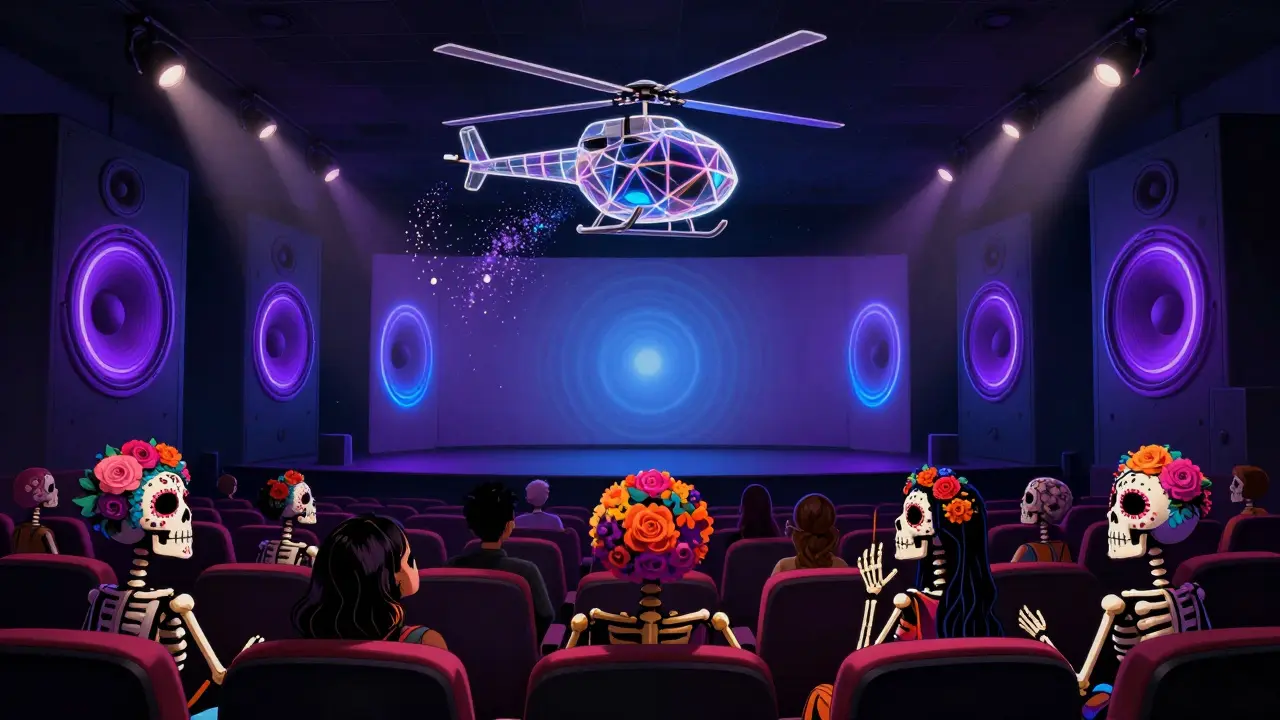
In a theater equipped with Dolby Atmos or DTS:X, sound isn't just left and right; it’s above, below, and behind you. When a helicopter flies overhead in a movie, the sound moves physically over your head. This movement creates a sense of presence that stereo sound cannot match. It tricks your brain into thinking you are inside the scene, not watching it from a distance.
Frequency plays an equally crucial role. Bass frequencies (below 100 Hz) are felt rather than heard. They vibrate the floor and your body. During an explosion, the initial blast is often a deep sub-bass drop that rattles your ribs, followed by the mid-range crunch of debris and the high-range hiss of shrapnel. This dynamic range-from the deepest lows to the sharpest highs-creates a physical reaction. Your heart rate increases, your muscles tense, and you become fully engaged.
Conversely, silence is used strategically. Just before a major reveal or attack, sound designers will often cut all background noise. This sudden vacuum forces the audience to hold their breath. When the sound returns, it hits harder because of the contrast. This technique, called a Sound Drop, is a deliberate removal of audio elements to heighten tension or emphasize a subsequent sound. It’s a psychological lever that pulls the viewer deeper into the narrative.
Technology Shaping the Future of Action Audio
The tools available to sound designers have evolved dramatically. In the past, everything was analog-physical tape reels, magnetic loops, and manual mixing boards. Today, digital audio workstations (DAWs) like Pro Tools allow for infinite precision. Designers can isolate specific frequencies, time-stretch audio without changing pitch, and automate volume changes frame-by-frame.
Artificial Intelligence is beginning to play a role too. AI algorithms can now analyze video footage and automatically generate basic sound effects based on visual cues. For example, if the software detects footsteps on pavement, it can insert a corresponding footstep sound library. While this speeds up the workflow for background noise, it lacks the creative nuance of human design. The best action sequences still require a human touch to decide *which* footstep sound fits the character’s mood or the story’s pacing.
Home viewing experiences are also catching up. With the rise of object-based audio formats in streaming services, you no longer need a massive home theater setup to feel immersed. Modern soundbars and headphones use binaural rendering to simulate surround sound. This means the intricate details of a gun reload or a sword clash are preserved even on smaller devices, keeping the impact intact regardless of where you watch.
Common Pitfalls in Action Sound Design
Not all action movies get it right. Poor sound design can ruin even the most visually stunning sequence. Here are a few common mistakes that break immersion:
- Muddy Mixing: When dialogue, music, and effects compete for the same frequency range, nothing stands out. The result is a wall of noise that fatigues the listener.
- Inconsistent Physics: If a small object makes a huge boom sound while a large explosion sounds weak, the brain rejects the reality of the scene. Scale must be respected.
- Overuse of Sub-Bass: Constant rumbling desensitizes the audience. When the big moment arrives, there’s no contrast left to create excitement.
- Ignoring Ambience: An action scene set in a canyon should echo. One in a padded room should be dead. Ignoring the acoustic properties of the location makes the world feel fake.
Avoiding these pitfalls requires discipline. Great sound design is invisible when done correctly. You shouldn't notice the individual sounds; you should only feel the emotion they convey. Whether it’s the terrifying silence before a jump scare or the exhilarating roar of a rocket launch, the goal is always the same: to make you forget you're sitting in a chair.
Conclusion: The Invisible Hero
Action sound design is the backbone of cinematic excitement. It transforms pixels on a screen into tangible experiences that resonate with our bodies and minds. From the careful selection of a watermelon for a punch to the complex layering of jet engines and animal roars, every decision is calculated to maximize impact. As technology advances, the possibilities for immersion will only grow, but the core principle remains unchanged: sound tells the truth of the action. Next time you watch a blockbuster, pay attention to what you hear. You might just find that the loudest moments are the ones carefully crafted to make you feel alive.
What is Foley art in action movies?
Foley art is the practice of recreating everyday sound effects, such as footsteps, cloth movement, and fight impacts, in a studio setting. In action movies, Foley artists use unconventional props like raw meat, breaking vegetables, and cracking leather to create realistic and impactful sounds for punches, kicks, and environmental interactions that were not captured clearly during filming.
How do sound designers make car engines sound more powerful?
Sound designers enhance car engine sounds by recording real engines under extreme conditions and then layering additional elements. They often add low-frequency bass boosts for rumble, high-frequency whines for speed, and sometimes even animal roars (like lions or bears) to give the engine a predatory, aggressive character that feels more intense than reality.
Why do action movies use so much bass?
Bass frequencies are felt physically by the human body, not just heard. In action movies, deep sub-bass is used to create a visceral reaction, simulating the shockwave of explosions or the weight of heavy machinery. This physical sensation increases tension and engagement, making the audience feel present in the scene.
What is the difference between spatial audio and stereo sound?
Stereo sound places audio in a two-dimensional plane (left and right channels). Spatial audio, such as Dolby Atmos, adds height and depth, allowing sounds to move freely in a three-dimensional space around the listener. This includes sounds coming from above, behind, or below, creating a much more immersive and realistic experience.
Can AI replace human sound designers?
AI can assist with repetitive tasks like generating basic ambient noise or syncing simple footsteps to video. However, it cannot replace the creative intuition of human sound designers. Crafting emotional arcs, choosing unique sound sources for metaphorical effect, and balancing complex mixes require artistic judgment and storytelling skills that AI currently lacks.