
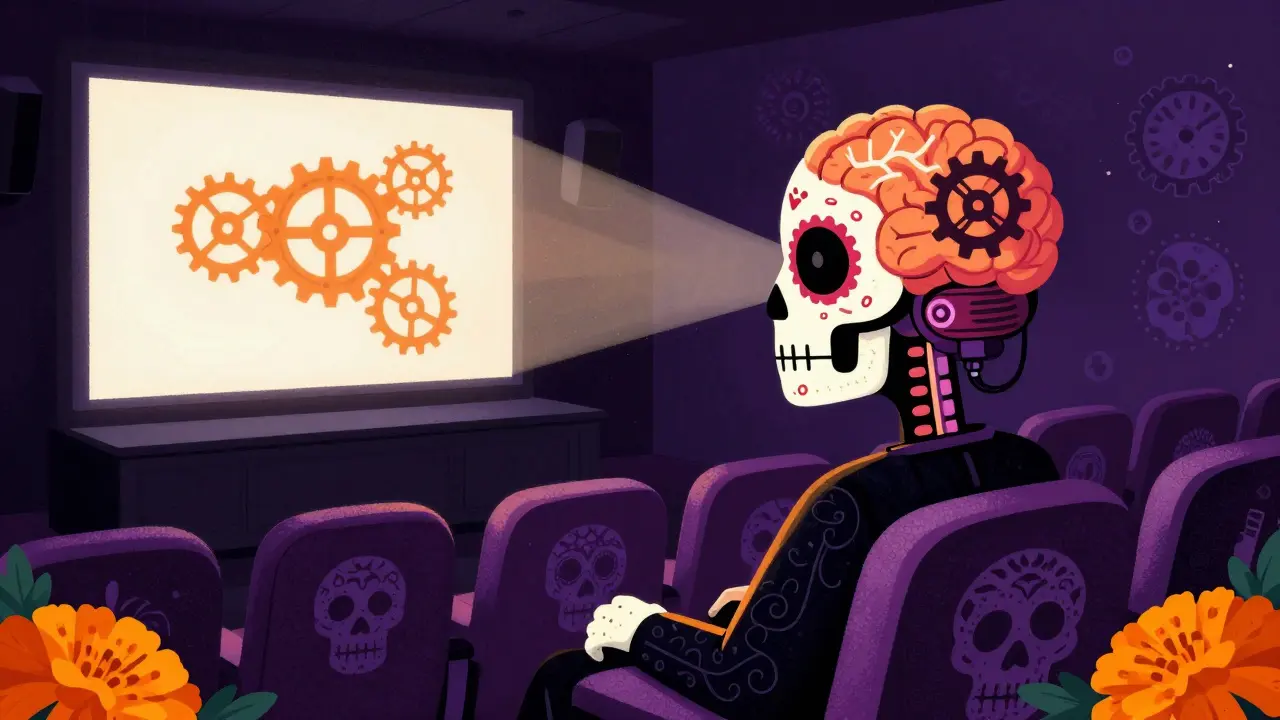
Why do you hold your breath when the killer steps into the hallway? Why does a minor key chord make your skin crawl before you even realize it? You aren’t just watching a movie; your brain is actively solving a puzzle. Cognitive Film Theory is an approach to understanding how viewers process narrative structure, emotional cues, and visual information while watching cinema. It moves beyond asking what a film "means" in a symbolic sense and asks how your mind actually constructs that meaning in real time.
This framework treats you not as a passive sponge absorbing images, but as an active participant filling in gaps, predicting outcomes, and regulating emotions. When you watch a thriller, your brain isn't just seeing light on a screen-it’s running complex simulations of danger, empathy, and suspense based on years of learned cultural codes and biological instincts.
The Active Viewer: Filling in the Gaps
Most people assume that if they see something on screen, they understand it instantly. But cognitive researchers like David Bordwell, a leading scholar who pioneered cognitive approaches to film analysis in the late 1980s argue that much of what you "see" is actually inferred. This process is called schema activation.
Your brain holds mental frameworks-schemas-for common situations. If you see a character pick up a phone, your brain automatically activates a "phone call" schema. You expect them to dial, wait for an answer, and speak. The director doesn’t need to show every step because your mind fills in the blanks. This efficiency allows filmmakers to tell complex stories without showing every mundane detail.
- Schemata: Mental shortcuts that help you interpret familiar actions (e.g., opening a door means entering a room).
- Inference: The logical leap you make when information is missing (e.g., assuming two characters met earlier because they greet each other warmly).
- Continuity: The assumption that space and time remain consistent unless signaled otherwise.
When a film breaks these expectations-like showing a character walking through a door but ending up in a different city-your brain has to work harder. This creates confusion or surprise, depending on whether you can quickly update your schema. Great directors manipulate these schemas to control your attention and emotional response.
Narrative Causality: Connecting the Dots
You don’t just watch events; you connect them. Cognitive film theory emphasizes narrative causality, the viewer's tendency to link events together through cause-and-effect relationships rather than mere chronological sequence. This is why montage sequences work so well. Even if scenes are unrelated geographically, you find meaning by linking them emotionally or thematically.
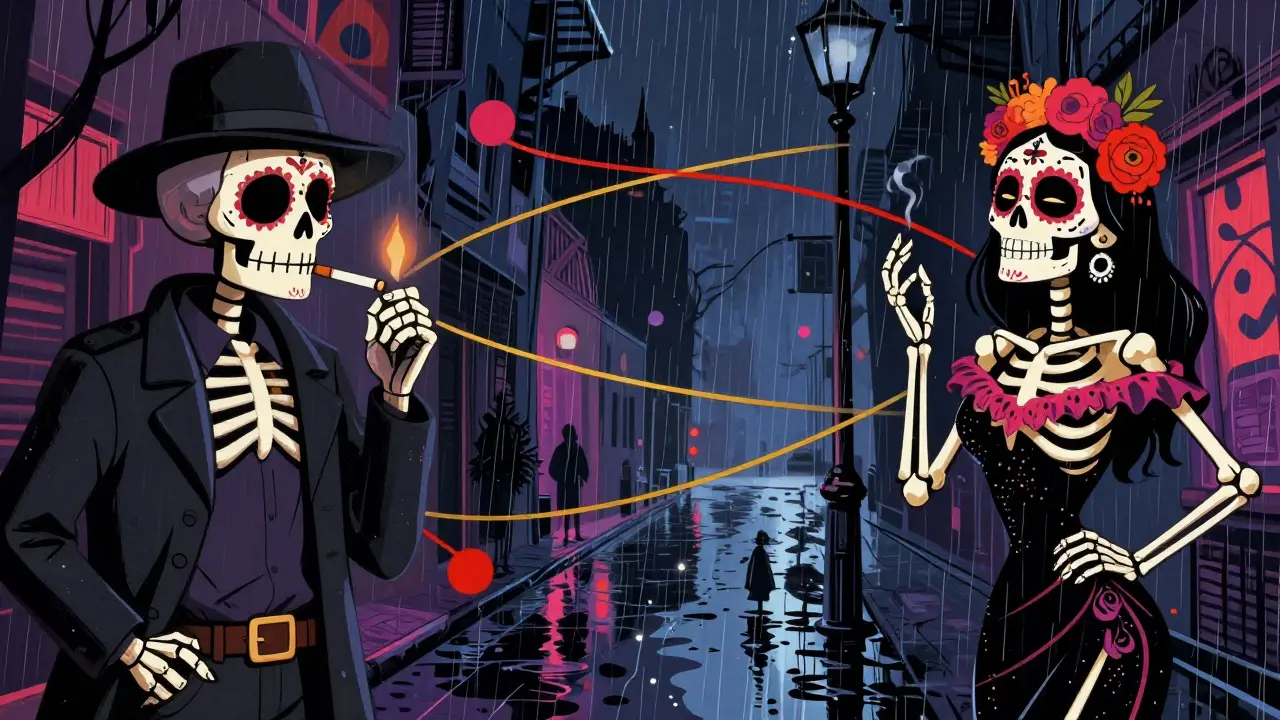
Consider a classic noir film. A detective lights a cigarette. Cut to a rain-slicked street. Cut to a femme fatale laughing. Chronologically, these moments might be separate. But cognitively, you weave them into a single mood: danger, mystery, tension. Your brain seeks patterns. If Event A happens, then Event B follows, you assume A caused B-or at least contributed to it.
This drive for causal connection explains why plot holes frustrate us so deeply. When a character suddenly knows something they couldn’t possibly know, your internal logic engine crashes. You feel cheated because the film failed to provide the necessary cognitive links. Filmmakers who master this craft ensure every cut serves a logical or emotional purpose, keeping your inference engine humming smoothly.
Emotional Engagement: Empathy and Suspense
If narrative is the skeleton, emotion is the flesh. How does a collection of pixels trigger genuine fear, joy, or sadness? Cognitive theorists point to two main mechanisms: empathy simulation and the neurological process where viewers mirror the facial expressions and bodily states of characters, and suspense generation, the psychological state created when viewers anticipate a negative outcome but lack control over preventing it.
Empathy works through mirror neurons. When you see a character flinch, your own neural pathways fire slightly, creating a subtle physical sensation of being hit. This is why close-ups are so powerful. They give your brain high-resolution data about micro-expressions-a slight twitch of the eye, a tightening of the jaw-that signal inner turmoil more effectively than dialogue ever could.
Suspense operates differently. It relies on knowledge disparity. You know the bomb is under the table; the characters don’t. This creates anxiety because your predictive models are screaming "danger!" while the characters act normally. The longer the scene drags out, the more intense the cognitive dissonance becomes. Alfred Hitchcock famously described this as the difference between surprise (short shock) and suspense (extended dread). Cognitive theory confirms his intuition: uncertainty combined with high stakes maximizes emotional arousal.
| Mechanism | Cognitive Process | Key Trigger | Viewer Experience |
|---|---|---|---|
| Empathy Simulation | Mirror neuron activation | Close-up facial expressions | Felt bodily resonance |
| Suspense Generation | Predictive error monitoring | Knowledge disparity (viewer knows more) | Anxiety and anticipation |
| Aesthetic Appreciation | Pattern recognition | Visual symmetry or color harmony | Calming pleasure |
Perceptual Processes: Seeing What Isn't There
Your eyes don’t record video like a camera. They scan, jump, and fixate. Cognitive film theory studies eye-tracking data, scientific measurements of where viewers look during film playback to understand how directors guide your attention. Bright colors, movement, and faces naturally draw your gaze. Editors use this biology to their advantage.
When a scene is chaotic, your brain struggles to prioritize information. Good editing simplifies the visual field. By isolating the most important element-the gun, the letter, the lover’s face-the director reduces cognitive load. If everything moves, nothing matters. Clarity comes from constraint.
Depth perception also plays a role. Although screens are flat, your brain interprets perspective cues-overlapping objects, relative size, atmospheric haze-to create a 3D space. Directors manipulate depth to control intimacy. Shallow depth of field blurs the background, forcing you to focus on the foreground action. Deep focus keeps everything sharp, inviting you to explore the entire frame for hidden details. Each choice changes how actively you engage with the image.
Memory and Recall: The Afterlife of the Image
A film ends, but its impact lingers. Cognitive theory examines how movies encode memories. Not all scenes stick equally. Highly emotional moments-especially those involving surprise or moral violation-are encoded more strongly due to adrenaline release. These become "flashbulb memories," vivid and long-lasting.
However, memory is reconstructive, not reproductive. You don’t replay the film exactly as it happened. You rebuild it from fragments, influenced by later experiences, conversations, and even spoilers. This is why rewatching a movie feels different. On the second viewing, your schema is already primed. You notice foreshadowing you missed before. The narrative shifts from discovery to appreciation of craft.
Repeated exposure strengthens neural pathways associated with specific motifs. A recurring musical theme, a visual symbol, or a character trait becomes easier to process over time. This fluency creates pleasure. As familiarity grows, the brain rewards you with a sense of mastery. You feel smarter for catching the clue. This feedback loop encourages repeat viewings and deepens engagement with the text.
Challenges and Critiques of the Approach
No theory is perfect. Critics argue that cognitive film theory ignores historical context, ideology, and cultural specificity. Just because humans share basic perceptual mechanisms doesn’t mean we interpret symbols identically. A red flag might signal danger in one culture and revolution in another. Schema activation depends heavily on prior knowledge, which varies widely across demographics.
Additionally, focusing too much on universal processes risks flattening unique artistic voices. Not every great film relies on clear causality or realistic empathy. Avant-garde cinema often deliberately disrupts schemas to provoke discomfort or new ways of seeing. Reducing such works to "failed communication" misses their point entirely.
Yet, despite these limitations, cognitive theory provides invaluable tools for analyzing how films function mechanically. It bridges the gap between subjective experience and objective observation. By understanding the rules of perception, emotion, and memory, both creators and critics can better articulate why certain techniques resonate-and why others fall flat.
What is the main goal of cognitive film theory?
The main goal is to explain how viewers mentally construct meaning from cinematic stimuli. It focuses on processes like perception, memory, emotion, and problem-solving rather than interpreting symbolic content or authorial intent.
How does cognitive theory differ from psychoanalytic film theory?
Psychoanalytic theory views the viewer as driven by unconscious desires and fantasies, often rooted in Freudian concepts. Cognitive theory treats the viewer as an active, rational processor using conscious and subconscious heuristics to navigate narrative and visual information.
Can cognitive film theory explain why horror movies scare us?
Yes. It attributes fear to mismatched expectations and heightened physiological arousal. When a film violates safety schemas (e.g., a safe home invaded), the brain triggers a threat response. Sound design and sudden cuts amplify this reaction by startling the orienting reflex.
Who are the key figures in cognitive film theory?
Key scholars include David Bordwell, Noël Carroll, and Murray Smith. They developed foundational texts in the 1980s and 1990s that shifted film studies toward empirical and psychological explanations of spectatorship.
Does cognitive theory apply to non-narrative films?
It applies less directly. Non-narrative or abstract films challenge standard schemas of causality and character identification. However, cognitive principles still govern perception, pattern recognition, and aesthetic pleasure, even when traditional story structures are absent.