

American Beauty didn’t just win Oscars-it cracked open the quiet horror of middle-class American life in the late 1990s. Released in 1999, this film wasn’t about grand explosions or epic journeys. It was about a man staring at a plastic bag dancing in the wind and realizing, too late, that he’d spent his life asleep. Directed by Sam Mendes and starring Kevin Spacey as Lester Burnham, it became a cultural lightning rod because it didn’t pretend suburbia was perfect. It showed how broken it really was.
The Quiet Desperation of Lester Burnham
Lester Burnham isn’t a villain. He’s a man who wakes up one morning and decides he’s done pretending. At 42, he’s a mid-level executive at a newspaper, married to Carolyn (Annette Bening), a real estate agent obsessed with appearances, and father to Angela (Mena Suvari), a teenage girl who thinks popularity is the same as worth. Lester’s transformation starts small: he quits his job, starts working at a fast-food chain, buys a classic car, and begins lifting weights. But underneath the surface, he’s trying to reclaim something he never realized he lost: agency.The film doesn’t romanticize his rebellion. It shows how messy it is. He fantasizes about Angela, not because he’s evil, but because she represents the youth and freedom he feels he’s missed. His desire isn’t predatory-it’s desperate. He’s not trying to steal her innocence. He’s trying to steal back his own.
Carolyn’s Performance of Perfection
Carolyn Burnham is the flip side of Lester’s collapse. She’s the embodiment of the American Dream sold in real estate brochures and self-help books. She reads motivational tapes in the car. She keeps her house immaculate. She smiles through panic attacks. Her entire identity is built on control-control over her image, her home, her marriage. But when she starts an affair with her rival, Buddy Kane, it’s not about love. It’s about proving she still matters.The scene where she stands in her kitchen, holding a knife, staring at her reflection while her husband watches from the doorway, says everything. She’s not angry. She’s empty. The house, the car, the money-they’re all props. And when the props start to crack, so does she.
The Teenagers and the Illusion of Control
Angela and Ricky Fitts (Wes Bentley) are the film’s two teenage lenses. Angela is the girl who thinks she’s the center of the universe. She wears her sexuality like armor, repeating phrases she’s heard in magazines: “I’m so popular.” But she’s terrified. She doesn’t know who she is outside of what boys think of her. When Lester tells her she’s beautiful, she doesn’t believe him. She thinks he’s lying to get into her pants. He’s not. He’s just the first adult who’s seen her as a person, not a fantasy.Ricky, on the other hand, is the quiet observer. He films everything-flies, raindrops, his father’s rage-with a handheld camera. He doesn’t talk much, but when he does, it cuts through the noise. His most famous line: “Sometimes there’s so much beauty in the world, I feel like I can’t take it.” He’s the only one who sees the real world beneath the surface. He doesn’t judge. He just records.

The Fitts Family: Violence and Repression
Colonel Frank Fitts (Chris Cooper) is the film’s most terrifying character-not because he’s violent, but because he’s terrified. He’s a retired Marine who runs his house like a military base. He hates what he doesn’t understand. He hates Ricky’s camera. He hates the way Ricky looks at boys. He hates the fact that he might feel something he can’t name.When he catches Ricky filming him, he doesn’t yell. He whispers, “You’re a faggot.” Then he breaks down. He’s not angry. He’s ashamed. He’s been taught that love between men is evil. And now, he’s realizing he might have felt it. He doesn’t know how to process that. So he kills.
The Plastic Bag and the Meaning of Beauty
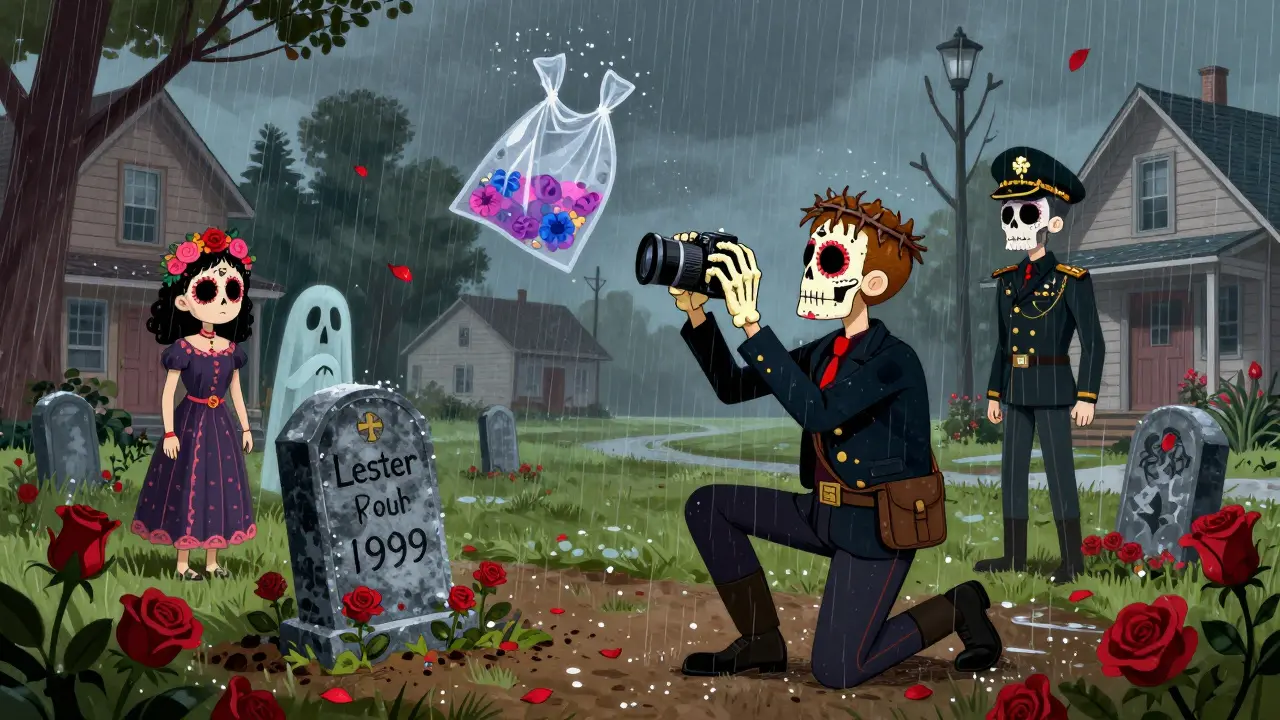
The opening voiceover says: “In my neighborhood, everyone has a story. Mine starts with death.” The film ends with Lester’s death-but not before one of the most hauntingly beautiful moments in cinema: a plastic bag swirling in the wind, caught in a gust of air, dancing without purpose, without control, without fear. Lester narrates it as his final thought: “I’ve never felt more alive.”This isn’t just a pretty image. It’s the thesis of the whole film. Beauty isn’t in the perfect lawn or the new car or the prom queen. It’s in the chaos. In the randomness. In the things we ignore because they don’t fit the script. The plastic bag doesn’t care if it’s beautiful. It just is. And that’s the point.
Why This Film Still Resonates in 2026
We’re not living in the 1990s anymore. But the pressures haven’t changed. We still chase the illusion of control. We still measure our worth by our jobs, our homes, our social media likes. We still pretend that if we just buy the right thing, wear the right clothes, say the right things, we’ll be happy.American Beauty doesn’t offer solutions. It doesn’t tell you to quit your job or start filming your life. It just asks: Are you awake? Are you really seeing what’s around you? Or are you just going through the motions, waiting for something to happen?
It’s no coincidence that the film’s most quoted line-“I’ve never felt more alive”-comes right before death. It’s not a warning. It’s a revelation. You don’t need to die to feel alive. You just need to stop pretending.
The Legacy of a Film That Changed How We See Suburbia
American Beauty won seven Oscars, including Best Picture, Best Director, and Best Actor for Kevin Spacey. But its real legacy isn’t on the award stage. It’s in the quiet conversations it started. In the people who watched it and realized, “That’s my dad.” Or “That’s me.”It inspired a wave of films that looked beneath the surface of ordinary lives-Little Miss Sunshine, The Royal Tenenbaums, Blue Valentine. But none of them had the same raw honesty. American Beauty didn’t mock suburbia. It mourned it. And in that mourning, it gave us something rare: permission to feel broken, and still be human.
Is American Beauty based on a true story?
No, American Beauty is not based on a true story. It’s a fictional screenplay written by Alan Ball, who drew from his own experiences growing up in suburban America and his observations of middle-class disillusionment. The characters and events are invented, but the emotions-loneliness, repression, the search for meaning-are deeply real.
Why did Lester Burnham die at the end?
Lester’s death isn’t a punishment-it’s a release. He finally feels alive in the moments before he dies: laughing with his daughter, watching the plastic bag, remembering what it felt like to be curious. Colonel Fitts kills him out of fear and confusion, not malice. Lester’s death is the tragic consequence of a society that can’t tolerate vulnerability. He didn’t die because he was bad. He died because he dared to be real.
What does the red rose symbolize in American Beauty?
The red rose is a recurring symbol of desire, beauty, and decay. It appears in Lester’s fantasies, on Carolyn’s table, and in the final shot of the film. Red is the color of passion, but also of blood and death. The roses are beautiful-but they’re cut, arranged, and controlled, just like the lives of the characters. They’re perfect on the outside, but dying inside.
Was Kevin Spacey’s performance praised at the time?
Yes. Kevin Spacey’s performance as Lester Burnham was widely acclaimed. He won the Academy Award for Best Actor in 1999, along with a Golden Globe and a BAFTA. Critics called it a career-defining role, noting how he portrayed quiet desperation with startling realism. His physical transformation-losing weight, adopting a slumped posture-made Lester feel painfully human.
Is American Beauty a critique of capitalism?
Yes, but indirectly. The film doesn’t mention capitalism by name, but it shows how consumer culture shapes identity. Carolyn measures her success by her real estate sales. Lester’s worth is tied to his corporate job. Even Ricky’s camera is a product he uses to find meaning. The film argues that when you define yourself by what you own or what you earn, you lose the ability to feel anything real.