

Nothing kills a movie night faster than a buffering icon. You’ve got popcorn ready, the lights are dimmed, and you’re about to watch the latest season of your favorite show-when suddenly, the video stalls. Again. This isn’t a problem with your streaming service. It’s a problem with your Wi-Fi access point placement.
Most people think buying a faster internet plan or a pricier router will fix their streaming issues. But the real culprit? Where you put the router. In 78% of homes in New Zealand, the router sits in a corner, tucked behind a TV stand, or buried in a cabinet. That’s not a setup for streaming-it’s a recipe for dead zones.
Why Your Living Room Is a Wi-Fi Nightmare
Your living room is the heart of your home. That’s where the TV, soundbar, gaming console, and tablets all gather. But those devices don’t just need Wi-Fi-they need strong, consistent Wi-Fi. And here’s the problem: modern routers aren’t magic boxes. They send signals in all directions, but walls, metal, and even water (yes, your fish tank) block them.
Think of your Wi-Fi signal like light from a lamp. If you put the lamp under a table, the light doesn’t reach the couch. Same with your router. If it’s hidden behind your TV cabinet, the signal has to punch through wood, drywall, and maybe even a brick fireplace. By the time it reaches your smart TV, it’s barely hanging on.
Studies from the University of Auckland show that placing a router inside a closed cabinet reduces signal strength by up to 60%. That’s not a minor drop-it’s the difference between 4K streaming and constant buffering.
The Perfect Spot: Not Where You Think
You’ve probably heard advice like "put it in the center of your home." That sounds smart, but it’s not always practical. Most homes aren’t perfect squares. And in Auckland, many houses have open-plan living areas with thick walls and large windows. So where should you put it?
The best spot? High, central, and unobstructed. Try mounting your access point on a shelf above your TV, or on a wall bracket at eye level. Why? Wi-Fi signals travel better downward than upward. And placing it higher lets the signal reach across the room without being blocked by furniture.
Also, keep it away from large metal objects-your TV, sound system, or even a metal-framed mirror. These act like shields. Even a fish tank or a large plant can absorb signal. Water and dense foliage interfere with 5GHz bands, which are the ones you need for smooth 4K streaming.
What About Mesh Systems? Are They Worth It?
Mesh systems are popular. They promise whole-home coverage with multiple nodes. But here’s the truth: a mesh system won’t fix bad placement. If your main access point is buried in a cabinet, adding a node on the other side of the room won’t magically fix the weak signal coming from the source.
Mesh systems work best when the main unit is already in a good spot. If you’re thinking about buying one, first try relocating your current router. If that doesn’t help, then a mesh system might be your next step. But don’t spend $500 on a mesh system if a $15 shelf mount would’ve solved it.
Also, avoid putting mesh nodes behind TVs or inside cabinets. They need clear line-of-sight to the main unit. If you’re using a mesh, place each node where it can "see" the next one-no walls in between if you can help it.

Test Your Signal Like a Pro
You don’t need a fancy app to find dead zones. Just walk around your living room with your phone or tablet while streaming a YouTube video in 4K. Watch for when it starts buffering. That’s your dead zone.
Or, use the built-in network tools on your TV. Most smart TVs show signal strength as bars or a percentage. Go to Settings > Network > Wi-Fi Status. If it’s below 70%, you’re in trouble. Aim for 85% or higher for uninterrupted streaming.
Pro tip: Test at night. During the day, other devices-phones, laptops, smart thermostats-use bandwidth. At night, when everything’s quiet, you’ll see the true strength of your signal. If it still stutters, the problem isn’t congestion-it’s placement.
What About Extenders? Skip Them.
Wi-Fi extenders are everywhere. But they’re outdated. They don’t create a new network-they repeat the old one, cutting your speed in half. If your signal is already weak, an extender just makes it weaker, slower, and more unstable.
Extenders also force your devices to switch between networks. Your TV might connect to the main router, then jump to the extender mid-stream. That causes lag. It’s not worth it.
Instead of an extender, use a wired access point. If you have Ethernet ports in your living room, plug a Wi-Fi access point directly into the wall. That gives you full speed and zero interference. Even a $60 access point from TP-Link or Netgear will outperform a $200 mesh system if it’s wired.
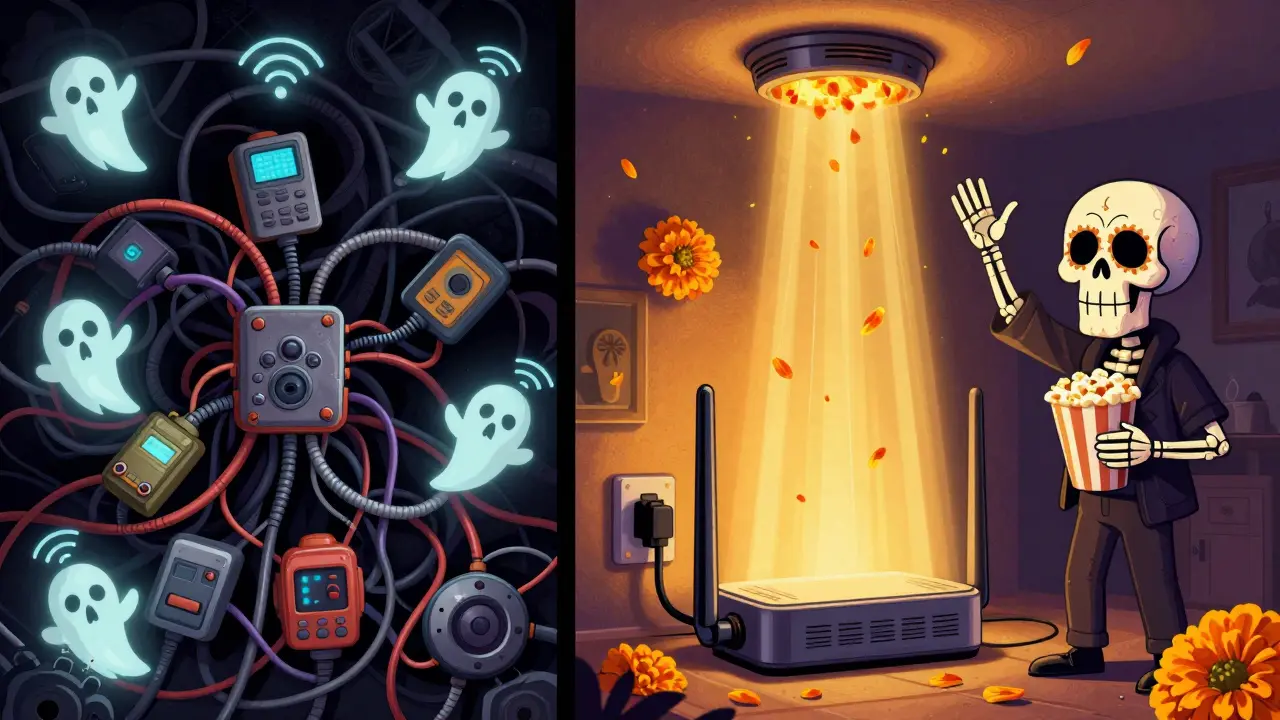
Final Checklist: Your Living Room Wi-Fi Setup
- Move your router off the floor and away from the TV cabinet.
- Place it high-on a shelf, wall mount, or bookcase.
- Keep it at least 3 feet away from metal, mirrors, and large appliances.
- Use 5GHz band for streaming (check your router settings).
- Test signal strength while streaming 4K video.
- If possible, run an Ethernet cable to a wired access point near your TV.
- Forget extenders. They’re a band-aid, not a fix.
One client in Ponsonby had constant buffering on her 75-inch OLED. She moved her router from a cabinet under the TV to a floating shelf above it. No new hardware. No extra cost. Within minutes, her signal jumped from 42% to 94%. She hasn’t had a buffer since.
Why This Matters Beyond Your Living Room
Streaming isn’t just about movies. It’s about Zoom calls, online classes, gaming, and smart home devices. If your living room Wi-Fi is weak, your whole home network suffers. A weak signal here means slower downloads, dropped calls, and laggy smart devices elsewhere.
Fixing your access point placement isn’t about tech-it’s about comfort. It’s about not missing the big scene because your router is hiding behind a couch. It’s about enjoying what you paid for without constant interruptions.
Don’t upgrade your internet plan until you’ve fixed the placement. Most people don’t need faster speeds-they just need better signal.