
There is a specific moment in every sci-fi or fantasy film where the audience stops watching a movie and starts believing in a world. It happens when a dragon exhales fire that feels hot enough to singe your eyebrows, or when an alien’s skin ripples with a texture you could almost touch. This suspension of disbelief isn’t magic; it is engineering. For decades, filmmakers have debated the merits of practical effects versus digital creatures. The truth? The most believable fantasies rarely pick a side. They build a bridge between the physical and the virtual.
We are living in an era where technology can render fur, water, and muscle movement with photorealistic precision. Yet, audiences still crave the weight, the light interaction, and the chaotic unpredictability of something real. Whether you are a VFX supervisor on a blockbuster or an indie filmmaker with a green screen made of bedsheets, understanding how to blend these two worlds is the key to creating monsters that haunt dreams rather than just eyes.
The Weight of Reality: Why Practical Effects Still Matter
When we talk about practical effects are physical techniques used during filming to create illusions, we aren't just talking about old-school makeup. We are talking about physics. A puppet, a suit, or a mechanical animatronic interacts with light, shadow, and the environment in ways that computers still struggle to replicate perfectly without massive computational cost.
Consider the actor’s performance. When a human actor shares the screen with a rubber suit or a puppeteer-controlled model, their reactions are genuine. Fear looks different when you are staring at a ten-foot-tall practical monster breathing down your neck compared to looking at a tennis ball on a stick. This emotional authenticity transfers to the audience. The creature has mass. It occupies space. It casts a shadow that matches the lighting rig exactly because it is physically there.
Take animatronics, for example. These are mechanical devices controlled by hydraulics, pneumatics, or electronics to simulate biological movement. In films like Star Wars (1977) or The Thing (1982), the horror came from the tangible gore and the mechanical jerkiness that felt organic yet wrong. Even today, directors like Guillermo del Toro rely heavily on practical elements. In The Shape of Water, the Amphibian Man was a combination of a suit worn by Doug Jones and detailed prosthetics. The result? A character who felt vulnerable, wet, and alive, not just a collection of polygons.
- Lighting Integration: Practical creatures reflect studio lights naturally, saving hours of compositing work.
- Tactile Feedback: Actors can touch, hold, and interact with the prop, grounding the scene.
- Unpredictability: Wind machines move fur; water splashes realistically. Chaos is hard to code cheaply.
The Infinite Canvas: The Power of Digital Creatures
On the other side of the spectrum sits CGI Computer-Generated Imagery used to create or enhance images in art, print media, video games, movies, and television shows. Digital creatures offer freedom that physical materials cannot match. You want a dragon to fly through a storm cloud while breathing fire that turns into ice? You can do that. You want a creature to shatter into a thousand pieces and reform? Easy. Digital tools allow for scale, speed, and complexity that would bankrupt any production if attempted practically.
The evolution of software like Houdini and Maya has revolutionized how we simulate biology. Artists use procedural generation to create textures that look like scales, feathers, or bark. They use muscle simulation systems to ensure that when a digital wolf runs, its muscles ripple under the skin just like a real animal. The breakthrough came with films like The Lord of the Rings, where Gollum was brought to life through motion capture. Andy Serkis’s performance was digitized, but the soul remained human. This proved that digital doesn't mean soulless.
In recent years, AI-assisted rendering has further blurred the lines. Tools can now predict how light bounces off subsurface scattering (the way light penetrates skin) in real-time. This means VFX artists can see near-final results while the camera is still rolling, allowing for faster adjustments. However, the risk remains: digital creatures can sometimes look "too perfect." Without the slight imperfections of reality, they fall into the uncanny valley-that eerie zone where something looks almost human but not quite, triggering a psychological rejection response in viewers.
The Hybrid Approach: Blending Physical and Virtual
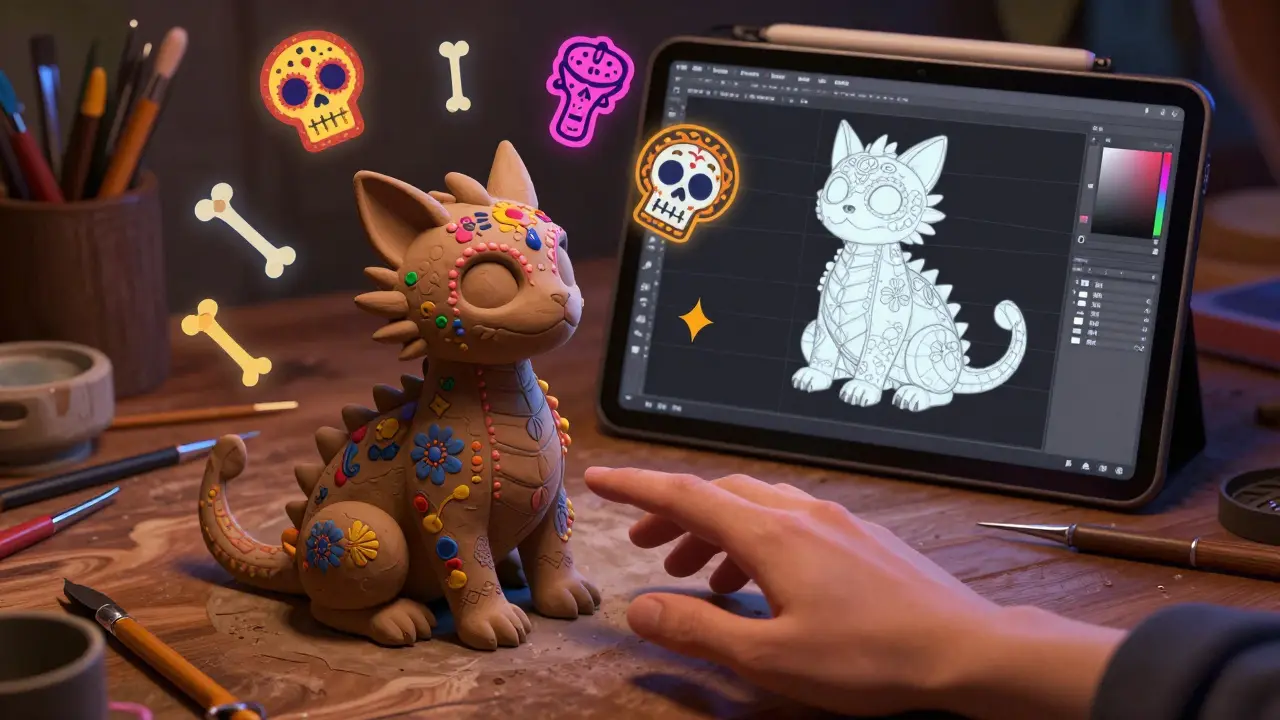
The secret to modern believability is not choosing one over the other, but layering them. This hybrid approach leverages the strengths of both disciplines. Typically, a production will start with a practical base-a maquette, a partial suit, or a reference model-and then extend it digitally. Or vice versa: a fully digital creature is placed in a practical environment to catch real reflections.
Let’s look at motion capture as the bridge. Actors wear suits dotted with markers that record their movements. This data drives the digital skeleton. But often, on set, there is also a stand-in-a person in a rough costume or a puppet-so the cinematographer knows where to focus the lens and the actors know where to look. This technique was masterfully used in Avatar. The Na’vi were entirely digital, but the performances were captured from real humans, and the environments were built with practical sets to provide authentic lighting references.
Another common technique is using prosthetics for close-ups and CGI for wide shots. If the camera is tight on a creature’s face, practical makeup provides micro-details like pores and sweat that are expensive to render. If the creature needs to leap across a canyon, CGI takes over. By switching seamlessly between the two, filmmakers maintain budget efficiency while maximizing visual fidelity.
| Feature | Practical Effects | Digital Creatures (CGI) |
|---|---|---|
| Cost Efficiency | High upfront cost for builds; low per-shot cost once built. | Low upfront cost; high per-shot cost depending on complexity. |
| Flexibility | Limited by physics; difficult to change after filming. | Infinite flexibility; easy to alter in post-production. |
| Actor Interaction | Direct physical interaction enhances performance. | Relies on imagination and stand-ins; less tactile feedback. |
| Lighting | Natural interaction with on-set lights. | Requires complex HDRI maps and rendering to match set lighting. |
| Scale | Difficult to create massive creatures without miniatures. | d>Excels at massive scale and impossible anatomy. |
Designing for Believability: Anatomy and Movement
Whether practical or digital, a creature must obey the laws of biology, even if those laws are bent. Audiences subconsciously analyze anatomy. Does the creature have enough muscle to support its size? Do its joints bend in a logical direction? If a dinosaur has six legs, do they coordinate in a tripod gait? These details matter.
creature design begins long before cameras roll. Concept artists sketch hundreds of variations, studying real-world animals for inspiration. A shark’s movement informs a deep-sea alien; a bird’s skeletal structure might influence a flying dragon. This process is called biomimicry. By grounding fantasy in reality, you create a subconscious link for the viewer. They recognize the parts, so they accept the whole.
Movement is equally critical. A static statue is impressive; a moving organism is terrifying or majestic. Animators study reference footage of animals. They break down locomotion into cycles: walk, run, idle, attack. For practical effects, puppeteers train for months to synchronize their movements. For digital effects, riggers create complex skeletons with inverse kinematics, allowing limbs to react naturally to forces. The goal is always the same: eliminate stiffness. Life is fluid, messy, and reactive.
Pitfalls to Avoid in Fantasy Filmmaking
Even with the best technology, mistakes happen. Here are common traps that break immersion:
- The Uncanny Valley: Making a creature too human-like without perfecting the details. Solution: Stylize the features or focus on non-humanoid designs.
- Ignoring Physics: A heavy creature landing without shaking the ground or displacing dust. Solution: Add secondary effects like debris, shockwaves, or camera shake.
- Flat Lighting: Digital creatures floating in a void. Solution: Use relighting passes to integrate shadows and highlights from the live-action plate.
- Overcrowding: Too many effects on screen at once. Solution: Focus on one hero element and keep the background simpler.
The Future of Creature Features
As we move deeper into the 2020s, the line between practical and digital continues to blur. Real-time engines like Unreal Engine are being used on set to display digital backgrounds and creatures instantly. Directors can see the final composite through the viewfinder, adjusting lighting and positioning in real-time. This reduces guesswork and speeds up production.
Furthermore, AI is beginning to assist in animation and texture generation. While it won’t replace the artistic vision of a creature designer, it can automate tedious tasks like simulating individual hairs or calculating crowd dynamics. The future belongs to hybrids-smart, efficient workflows that respect the history of practical effects while embracing the limitless potential of digital creation.
What is the difference between practical effects and CGI?
Practical effects are physical techniques performed during filming, such as puppets, animatronics, and makeup. CGI (Computer-Generated Imagery) involves creating images or animations using computer software. Practical effects offer tangible realism and natural lighting, while CGI offers unlimited flexibility and scale.
Why do some digital creatures look fake?
Digital creatures often look fake due to poor integration with lighting, lack of physical interaction with the environment, or unnatural movement. If a creature doesn't cast accurate shadows or displace air/dust, the brain rejects it as unreal. Additionally, falling into the 'uncanny valley' by mimicking humans imperfectly can cause discomfort.
How much does it cost to create a digital creature?
The cost varies wildly based on complexity and screen time. A simple digital extra might cost a few thousand dollars, while a hero character like Gollum or Thanos can cost millions. Factors include modeling, rigging, texturing, animation, and rendering time. Practical effects often have higher upfront build costs but lower per-shot expenses.
Can I use practical effects on a low budget?
Yes, practical effects can be very budget-friendly. Using household items, foam latex, or stop-motion animation can create convincing monsters without expensive software. The key is creativity and good lighting. Many indie horror films rely entirely on practical effects to achieve high impact with minimal resources.
What software is best for creating digital creatures?
Industry standards include Maya for modeling and animation, Houdini for procedural effects and simulation, and ZBrush for sculpting detailed textures. For real-time preview and game integration, Unreal Engine is increasingly popular. Blender is a powerful free alternative that supports the entire pipeline.